

Every part of forklifts is designed for a specific purpose. Their placement is an modern art of engineering. The type of equipment to provide load handling solutions must be selected according to the wished working requirement. Therefore, by knowing its parts you can make more informed decisions.
Mast
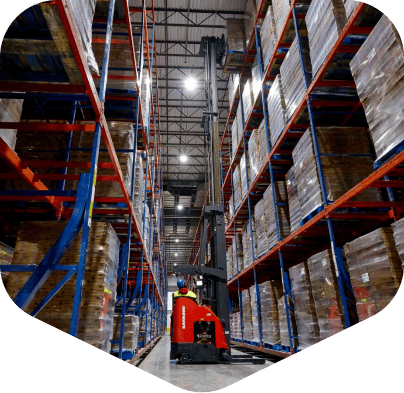
Mast is a set of masts and pistons that lift loads in forklifts. Masts are parts commonly used by forklifts, except in case of ITA Class III and Class VI which have no lifting.
Forklift mast can be :
- Channel Mast
- Extensible Mast (boom lift)
- Articulated Boom (folding)
- Single Mast
The most common forklift mast is the channel mast and it can be: simple, duplex, triplex, quad and even quintuple mast according to the number of sections forming the lifting.
Extensible and articled masts are most commonly used in aerial platforms and all-terrain Telehandlers (class VII forklift).
Single mast is a vertical version of extensible masts, which is not commonly used due to its complex maintenance.
|
|
Channel Mast Parts
Channels (sections) Channel rail Fork Carriage Fork Safety Fork |
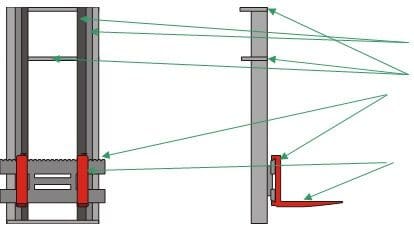
Mast Nomenclature
| Free Lift: It is the height forks are lifted without elevating sections, this is a key feature for equipment operating on restricted height areas and requiring lifting within that height, such as in containers and trucks. | 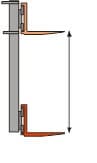 |
E.H.: (Elevated Height) Maximum fork lifting height. This height must be at least 6” higher than higher storage height | 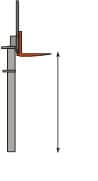 |
| OACH: (Overall Collapsed Height) Collapsed mast height is the height mast have when all sections are not lifted (collapsed), it is the minimum equipment height to pass through door or restricted height areas. | 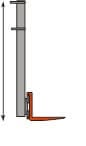 |
EX.H.: (Extended Height) Maximum equipment height including load support or cabin in case of Order Pickers, this height must be considered to verify if the equipment maximum lifting height doesn’t impact warehouse ceiling or lamps. This is the equipment size and it does not include load height, which could be larger and impact it | 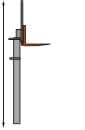 |
Forks
Forks are forklift parts which lift loads, basically there are 3 types depending on how it is attached to forklifts:
| Order Picker Forks are flat and assembled on a bar or bolt in forklifts cabin floor. | 
|
| Bar forks, used by old Reach and Swing Reach forklifts, are assembled in bars on fork carriages | 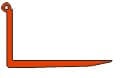 |
| ITA Standardized Forks de clip or hook are the most commonly used | 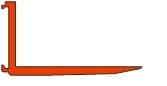 |
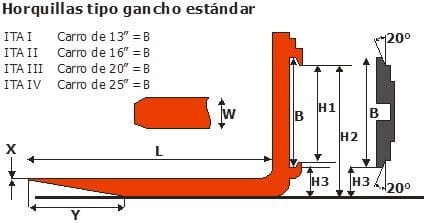
ITA classification for clip or hooks forks assembly
ITA has a classification for hook fork assembly according to equipment capacity and fork size, to fulfill ITA specifications, trucks must comply with size required and 20° assembly angle.
 |
Fork-Carriage Truck
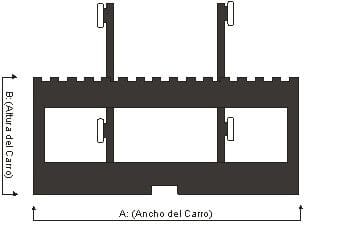
Another forklift part is the fork carriage track, fork carriage, truck height is classified according to ITA classification. In addition to regular fork carriages, you can add accessories to change fork carriage structure, most commonly known as “False fork carriage”, which increase fork carriage width and are not designed to hold load weight, only to “stabilize” larger loads.
|
|
Fork carriage trucks height depends on its load capacity and width is determined by its function.
Equipment truck widths of narrow aisle are usually from 31 to 34” and counterbalanced equipment with seated operator are from 37 to 41” Depending on forks used, fork support may vary. Width may vary depending on its function and you can find smaller or larger truck options. Equipment in narrow aisle, a larger width track may complicate lateral maneuvering. |
1.7. Tilt
Mast tilt can be performed by mast or by forks, tilts is required for load securing, for picking and lifting platforms and it is very useful with some accessories.
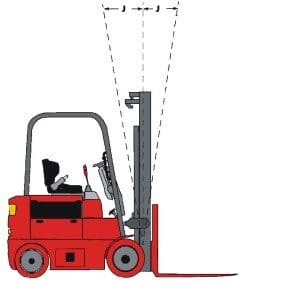 |
Most of equipment includes a 3° forward tilt and 5° backward tilt.
Counterbalanced forklifts with short mast usually include 6° forward, 8° backwards For heavy loads, large equipment and high masts it is limited to 3° forward and 3° backwards. One of the most commonly requested tilts is the bottling machine tilt, which is 10° forward, 5° backwards, used for cases of soda loads of delivery trucks, which has a steep tilt. In addition, bottling machine tilt is very useful for using accessories such as Push-Pull, considering that it makes it easy to plate and separate accessories. Some equipment has no tilt such as Order Pickers and Swing Reach
|